

.svg)





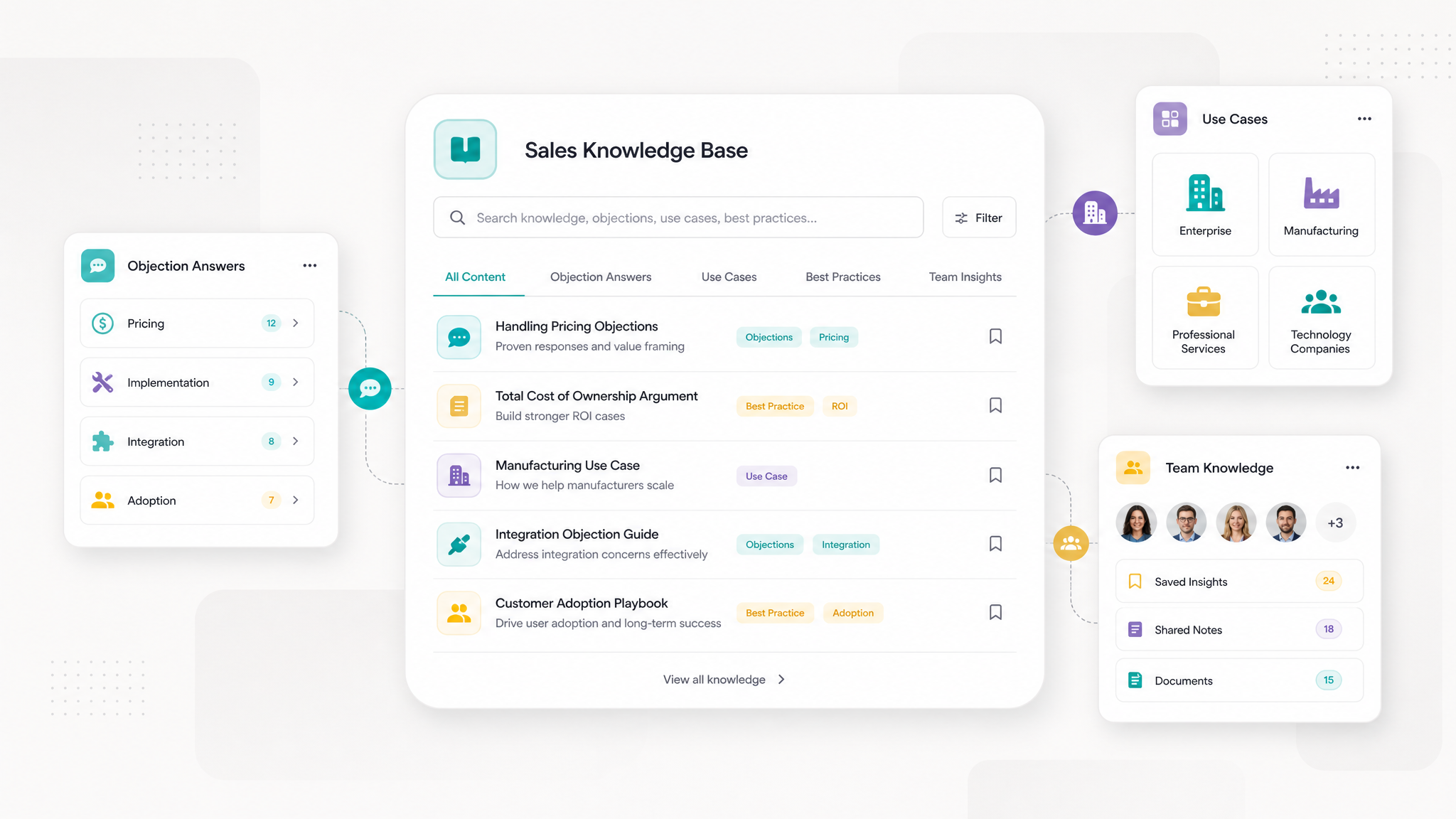
A sales knowledge base in CRM strengthens sales conversations by centralizing objection responses, use cases, success examples, and team experience.
How does a sales knowledge base differ from a product catalog?
Knowing product or service information is important in B2B sales, but what often makes a sales conversation strong is connecting that information to the customer’s problem. A product catalog explains what is sold. A sales knowledge base shows how that product or service should be positioned for a particular customer need, how different objections should be answered, and which use cases should be highlighted.
A sales knowledge base is therefore not an archive of technical documents. It is a structure that turns the sales team’s field experience, customer questions, successful narratives, and effective arguments into shared memory. Especially as the team grows or new representatives join, this shared memory makes sales quality more consistent.
Why do sales teams need a shared memory of arguments?
Over time, sales representatives encounter many customer objections. Questions such as “Your price is high,” “Our current system is sufficient,” “This is not our priority right now,” “Will installation be difficult?” and “Will our team use it?” recur across different customers. Yet good answers to these questions often remain within each representative’s personal experience.
Without a shared knowledge base, every representative responds to the same objections in their own style and from their own memory. This creates a strong sales experience in some conversations and a weak one in others. A sales knowledge base connected to CRM allows good practices to spread throughout the team.
Objection responses and frequently asked customer questions
Objection responses are among the most valuable parts of a sales knowledge base. The goal is not to suppress the customer’s objection with memorized sentences. A good objection response acknowledges the customer’s concern, understands the context, and builds confidence with accurate information.
Frequently encountered objections can be classified by topic in CRM. Recommended response frameworks can be created for subjects such as price, ease of use, transition process, management support, technical scope, team habits, or implementation time. The representative reaches the right argument more quickly within the context of the relevant opportunity or industry.
Use cases and success stories
Customers often want to hear use cases similar to their own business rather than abstract features. Instead of saying “this module exists,” being able to say “this problem was managed in this way at a similar field sales team” improves the quality of the conversation.
The sales knowledge base can contain industry-based use cases, example needs, solution narratives, and short success notes. This information can be written without sharing customer names. What matters is that the sales representative can quickly find a narrative suited to the customer’s industry and problem.
How should the knowledge base be structured within CRM?
To be usable, the knowledge base must be concise, searchable, and classified. Topic cards, objection headings, industry scenarios, customer questions, and recommended response frameworks may be more practical than long documents. Each piece of information can be related to a product, industry, customer type, or sales stage.
The CRM connection is important here. If an opportunity belongs to a particular industry or the customer has expressed a specific objection, the representative should be able to reach the relevant knowledge content easily. If the knowledge base remains in a separate folder outside CRM, it may not be included sufficiently in the daily sales flow.
What is the risk of outdated sales information?
Creating a sales knowledge base is not enough on its own; the information must remain current. An old pricing approach, technical information that is no longer valid, or arguments that have proved ineffective in the field can misdirect the representative. Content ownership and an update rhythm must therefore be defined.
The knowledge base should develop as the sales team brings in new objections and successful responses from the field. The system then becomes a living team memory rather than a static document archive. The manager or product team can also review the accuracy of this content periodically.
Make sales memory organizational with Konguru CRM
Konguru CRM helps sales teams manage customer, opportunity, offer, visit, and task information centrally. When a sales knowledge base approach is added to this structure, teams do not merely keep records; they also make information that works in the field available for shared use.
In B2B sales, every good conversation produces learning for future conversations. That learning cannot scale if it remains in personal memory. When it is structured in CRM, everyone from a newly hired representative to an experienced sales manager can benefit from the same organizational sales knowledge.
Request a Konguru CRM demo to manage your sales team’s objection responses, use cases, and team memory centrally.